A national framework for early nitrogen timing, soil protection and net environmental risk
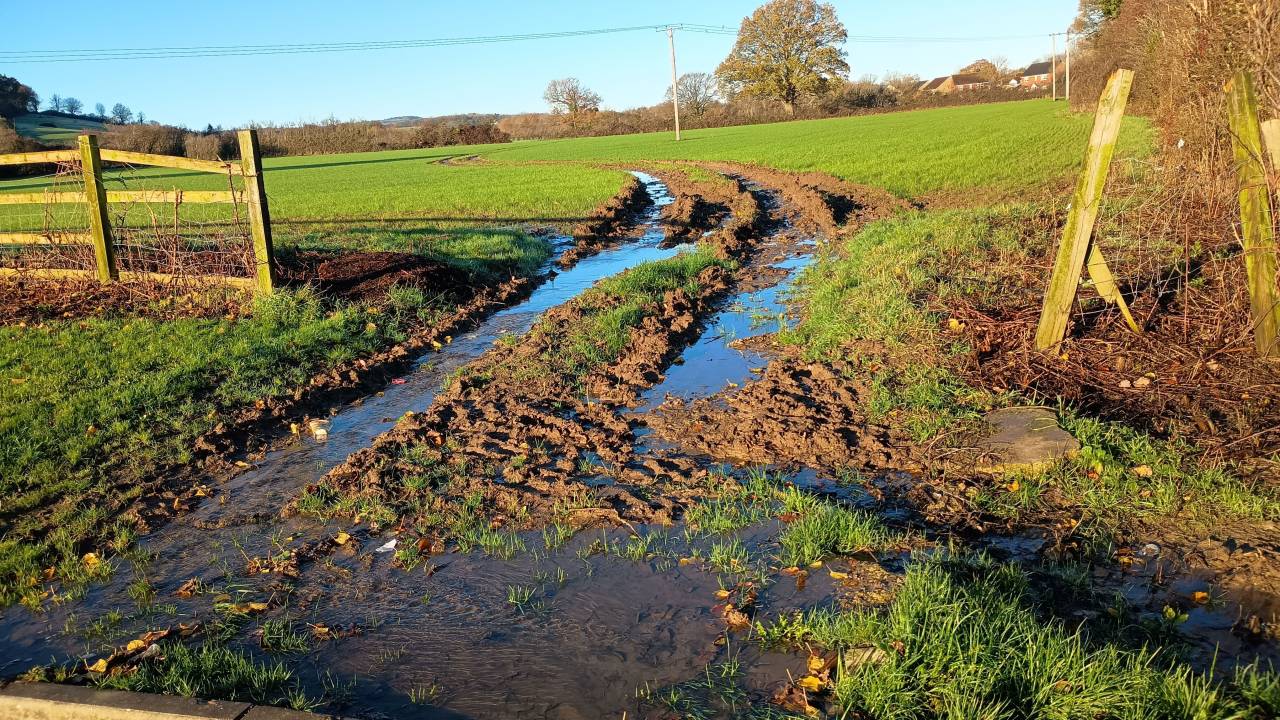
Every wet spring exposes a structural vulnerability in UK arable farming.
The crop progresses through GS25 to GS31 whether fields are trafficable or not. The window for first nitrogen is narrow. At the same time, enforcement pressure on nutrient losses to water is increasing, and the statutory position on applying to waterlogged soils is unequivocal.
This tension is no longer simply operational. It is national.
If early nitrogen timing is missed at scale, yield potential is lost across regions. If fertiliser is applied in unsuitable conditions or soils are damaged through trafficking, runoff risk increases and regulatory scrutiny intensifies. The solution cannot be weaker environmental standards, nor can it be accepting avoidable yield loss.
The challenge is to reduce net risk to yield, soil, water, and compliance simultaneously.
The Environmental Risk Is Explicit in Law
In England, Regulation 3 of The Reduction and Prevention of Agricultural Diffuse Pollution (England) Regulations 2018 (SI 2018/151) requires that organic manure or manufactured fertiliser must not be applied if “the soil is waterlogged, flooded or snow covered”.
That is a statutory prohibition.
Where land falls within a Nitrate Vulnerable Zone (NVZ), Regulation 16 of The Nitrate Pollution Prevention Regulations 2015 (SI 2015/668) requires the occupier to undertake a field inspection before spreading nitrogen fertiliser to consider the risk of nitrogen entering surface water. It also prohibits spreading where soil is waterlogged, flooded or snow covered. Additionally, it requires that manufactured nitrogen fertiliser must not be spread within 2 metres of surface water and must be spread “in as accurate a manner as possible”.
The legal framework demands:
- Soil condition assessment
- Runoff risk judgement
- Buffer discipline
- Application accuracy
Application method does not override these duties.
“Wet” Is Not a Single Condition
The regulatory red line is waterlogged soil.
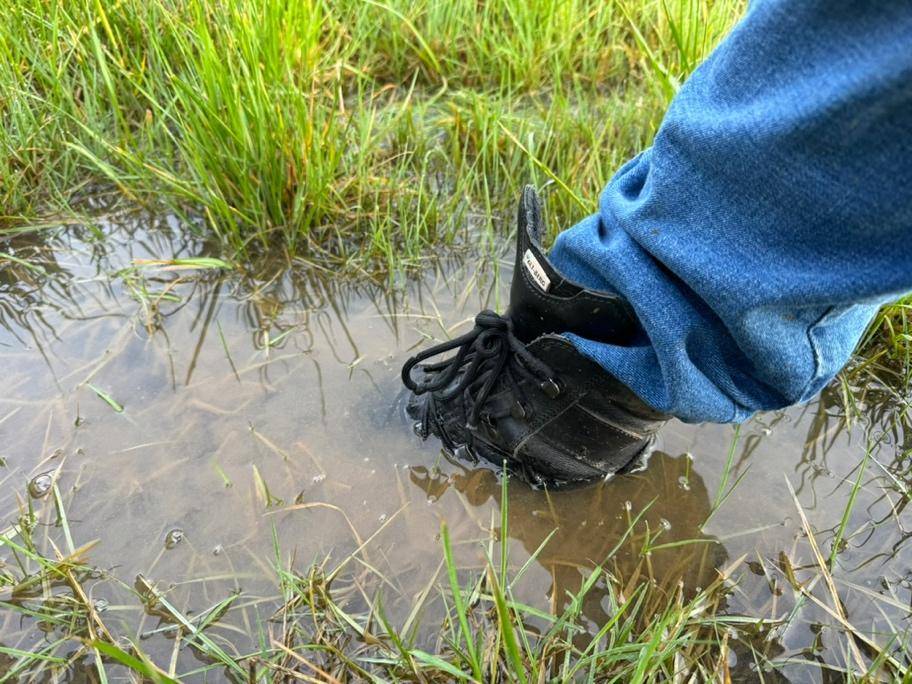
However, there is a clear operational distinction between waterlogged land and soil that is soft and vulnerable to trafficking but not saturated to the point of runoff risk.
A field might not be waterlogged and assessed as presenting no significant risk of diffuse pollution, yet structurally incapable of carrying heavy equipment without compaction.
Waterlogged soils present immediate runoff risk and must not receive nitrogen. That assessment must take account of forecast rainfall, slope, soil infiltration capacity and proximity to watercourses.
Soft but non-saturated soils present structural risk if trafficked. Confusing the two results either in unlawful application or avoidable yield loss.
Managing that distinction correctly is fundamental.
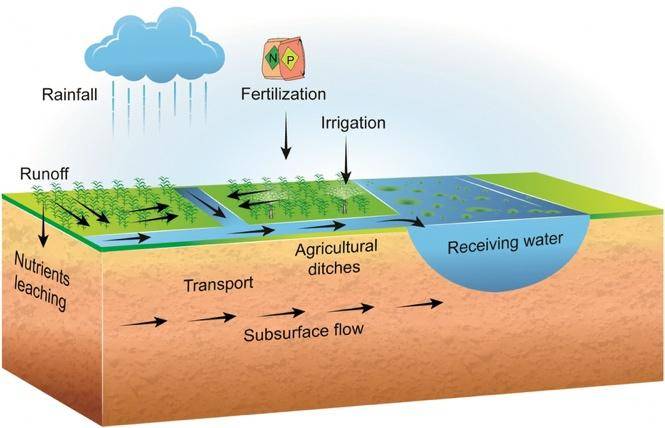
Image ref: Xia, Y., Zhang, M., Tsang, D.C.W. et al. Recent advances in control technologies for non-point source pollution with nitrogen and phosphorous from agricultural runoff: current practices and future prospects. Appl Biol Chem 63, 8 (2020).
The Agronomy of Late Tillering to Stem Extension (GS30–31) Is Clear
Early nitrogen timing materially influences winter wheat structure, particularly around the transition from late tillering into stem extension (GS30–31).
AHDB guidance notes that tillering governs canopy formation and that many tillers die between GS31 and GS61. It states that at least 400 fertile shoots per square metre are required for maximum yield and that higher nitrogen availability encourages tiller survival.
Peer-reviewed research by Efretuei et al. (2016) demonstrates the sensitivity of first nitrogen timing around this transition. In one season, delaying the first nitrogen application from GS30 to GS31 resulted in a 0.7 t/ha yield reduction. Further delays after GS31 resulted in reductions of at least 0.9 t/ha. In another season, similar yields were achieved when nitrogen was applied up to GS32, but delaying to GS37 resulted in a 0.9 t/ha reduction.
The implication is not that every year produces identical loss. The implication is that the downside risk of delaying nitrogen beyond the late tillering to early stem extension window is measurable and, in some seasons, severe.
Real World Yield Evidence: Harvest Data Comparison
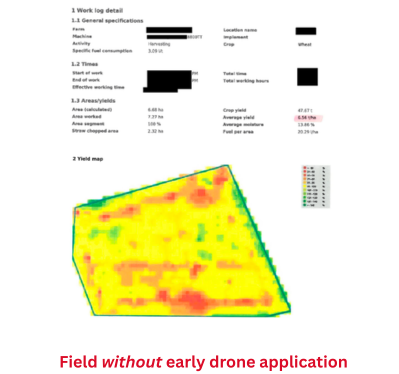
Harvest data recorded by a CLAAS combine harvester telematics system provides a useful operational comparison.
One winter wheat field, where no early fertiliser was applied by drone and nitrogen was instead applied more than a week later once machinery access was possible, recorded an average yield of 6.56 t/ha at harvest.
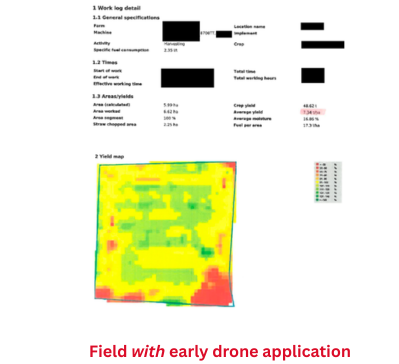
A comparable winter wheat field, where early fertiliser was applied by drone within the optimal timing window, recorded an average yield of 7.34 t/ha across.
The difference between the two harvested averages was 0.78 t/ha.
These figures are derived from machine-recorded harvest data rather than estimated values. While this is not a replicated scientific trial and field variability must be acknowledged, the comparison reflects real commercial output measured at harvest.
The key distinguishing factor between the two areas was timing. In one case nitrogen application was delayed until ground conditions permitted machinery access. In the other, nitrogen was applied earlier by drone when soils were not waterlogged but were unsuitable for trafficking.
The harvested yield differential aligns with the established agronomic evidence on early nitrogen timing.
The comparison is illustrative of timing impact within a commercial system rather than proof of isolated causation. However, the recorded difference is consistent with established agronomic evidence that protecting early nitrogen timing can materially influence final output.
The Financial Exposure at Scale
AHDB’s Arable Market Report of 10 March 2025 quoted feed wheat delivered into Yorkshire at £190.50 per tonne.
Using the AHDB reported price at the time of writing, as a reference:
- 0.7 t/ha equates to approximately £133 per hectare
- 0.9 t/ha equates to approximately £171 per hectare
- 0.78 t/ha equates to approximately £148 per hectare
Across 300 hectares, £148 per hectare represents over £44,000 of output. Across 1,000 hectares, it represents nearly £150,000.
Scaled nationally across winter wheat area, the aggregate impact of delayed nitrogen becomes material to UK production capacity.
This is structural yield preservation, not marginal gain.
Soil Compaction Is Also a Water Quality Issue
Compaction is not only an agronomic issue. It is hydrological.
Government evidence on runoff management confirms that reducing soil compaction increases hydraulic conductivity and improves water infiltration and storage. Compaction reduces infiltration and increases overland flow pathways.
Applying nitrogen within legal soil limits but trafficking soft soils with heavy machinery can increase long term runoff risk.
A 2020 scientific review in Applied Biological Chemistry identifies agricultural nitrogen and phosphorus runoff as major contributors to eutrophication once industrial point sources are controlled.
Protecting soil structure is therefore directly aligned with protecting water.
Net Risk: A Structured Framework for Decision Making
The decision in wet springs is not whether to apply nitrogen. It is how to minimise total system risk.
The Net Risk framework, developed as a decision framework for balancing multi-domain agricultural risk, recognises that risk must be assessed in aggregate, not in isolation. Reducing one visible risk while increasing another is not risk reduction. It is risk displacement.
In early nitrogen management, four risks operate simultaneously:
- Yield risk from delayed timing
- Soil structural risk from trafficking
- Water pollution risk from runoff
- Regulatory risk from non-compliance
Traditional decision making often isolates a single variable. Waiting reduces compaction risk but increases yield risk. Trafficking early protects timing but increases structural and runoff risk. Applying without structured inspection reduces yield risk but increases regulatory exposure.
Under a Net Risk framework, the objective is to reduce total risk across all four domains.
When soil is waterlogged, environmental and regulatory risk are extreme and application is prohibited. When soil is not waterlogged but structurally vulnerable, aerial application removes axle load from the equation while preserving timing.
This reduces:
- Long term infiltration decline
- Compaction driven runoff pathways
- Secondary pollution risk
While preserving:
- Nitrogen timing
- Crop response
- Compliance discipline
The system risk is reduced overall.
At national scale, this matters. If early nitrogen is systematically delayed because soils cannot carry machinery, yield loss becomes cumulative. If soils are systematically trafficked in marginal conditions, runoff risk accumulates across catchments.
Net Risk provides a framework for reducing total exposure rather than shifting it.
ASPN: National Capability, Not Local Experiment
This is where, the “AutoSpray Pilot Network”, ASPN, operates as national infrastructure rather than isolated service provision.
ASPN represents a coordinated UK-wide network of trained heavy lift drone operators operating under structured procedures, oversight, and consistent operational standards. Its national footprint allows mobilisation in response to regional weather constraints, not just individual field needs.
When soils are:
- Not waterlogged
- Not presenting immediate runoff risk
- But structurally unsuitable for heavy machinery
Aerial fertiliser application removes the trafficking variable while remaining fully compliant with statutory limits.
It enables:
- Application within legal soil condition thresholds
- Maintenance of 2 metre surface water buffers
- Demonstrable application accuracy
- Spatial exclusion of sensitive zones
- Structured record keeping
This is not a circumvention of regulation. It is a method of delivering compliance, soil protection, and agronomic timing together.

Application Uniformity and Pellet Integrity
Accuracy is not optional under NVZ regulations. It is required.
Granular fertiliser performance depends on pellet integrity. Pellets are engineered to specific size and density so they carry consistent nutrient loads and travel predictably during broadcast. Fractured pellets produce fines that alter distribution, shorten throw, increase striping risk, and increase drift susceptibility.
AutoSpray Systems has tested the distribution by XAG Drones:
- Pellet integrity has been recorded at 99.9 percent
- Swath width has been calibrated and measured
- Drift behaviour has been assessed
- Overlap parameters have been configured to deliver uniform coverage
Uniformity has been quantified rather than assumed.
For fertiliser application to be defensible at policy level, distribution performance must be demonstrable.
National Implications
The UK cannot afford systematic loss of early nitrogen timing across its winter wheat area. Nor can it afford continued deterioration in water quality linked to diffuse agricultural runoff.
If early nitrogen timing is preserved at scale while protecting soil structure and maintaining strict adherence to environmental law, the result is:
- Protected national yield capacity
- Reduced compaction driven runoff
- Stronger regulatory defensibility
- Increased public confidence in nutrient stewardship
The alternative is avoidable yield loss combined with rising environmental pressure.
Conclusion: Aligning National Policy With Operational Reality
The statutory position on waterlogged soils is clear. Nitrogen must not be applied where soil is waterlogged, flooded or snow covered. The agronomy is equally clear. Early nitrogen timing around GS25 to GS31 influences tiller survival and yield potential. Delay carries measurable downside risk. The soil science is clear. Compaction reduces infiltration and increases runoff pathways. The evidence now also shows that aerial fertiliser application, when deployed within statutory soil condition limits and with demonstrable accuracy, can preserve nitrogen timing without introducing trafficking damage.
The policy question is therefore not whether drones should be allowed. The legislation is already method neutral. The question is whether national guidance and industry frameworks fully recognise aerial capability as part of compliant nutrient management strategy. If the objective is to reduce diffuse pollution while protecting national yield capacity, guidance must reflect operational reality.
DEFRA guidance on nutrient management should explicitly address aerial application as a legitimate delivery method where:
- Soil is not waterlogged
- Runoff risk is assessed and acceptable
- Statutory buffers are maintained
- Application accuracy is demonstrable
- Records are retained
The NFU, AHDB, and catchment-based partnerships should incorporate aerial capability into best practice nutrient timing discussions rather than treating it as peripheral. UK agriculture is being asked to increase resilience, improve water quality, and maintain productivity simultaneously. The tools now exist to reduce net risk across all three.
National frameworks should reflect that.
Contact Us
Ready to take flight?

References
- The Reduction and Prevention of Agricultural Diffuse Pollution (England) Regulations 2018 (SI 2018/151), Regulation 3 “the soil is waterlogged, flooded or snow covered”.
- The Nitrate Pollution Prevention Regulations 2015 (SI 2015/668), Regulation 16 (field inspection, waterlogged restriction, 2 metre rule, accuracy requirement).
- AHDB: Leaf emergence and tillering growth stages in winter wheat (tiller survival, GS31 to GS61, 400 fertile shoots per m², high nitrogen encourages tiller survival).
- Efretuei, A. et al. (2016) Effect of nitrogen fertilizer application timing on nitrogen use efficiency and grain yield of winter wheat in Ireland (0.7 t/ha and at least 0.9 t/ha yield reductions with delays after GS30 and after GS31 in specific seasons).
- AHDB Arable Market Report 10 March 2025 (feed wheat delivered into Yorkshire £190.50/t reference price).
- UK Government Natural Flood Management evidence: Run off management (reduced compaction increases hydraulic conductivity and infiltration).
- Tsang et al. (2020) Recent advances in control technologies for diffuse pollution with nitrogen and phosphorus from agricultural runoff (eutrophication context and importance of reducing runoff pollution).
- CLAAS Telematics yield report